Sunday, April 29, 2012

An Unseen Friend


In the first month in Maheshpur, while I was trying to read by the light of the solar lantern, pausing now and then to ease my eyes so they don’t develop a permanent squint, I overheard snatches of conversation between Amal Babu and someone at the other end of the line. Amal Babu’s tone went from banter to argumentative and at times the heated exchanges made me worry that this could be the last phone conversation he would ever have with the person on the other end.  But, their relationship seemed to be made of very resilient stuff. The next evening the conversation started all over again as if nothing had happened the earlier night. These snatches of overheard yet indistinct conversations intrigued me no end. Perhaps understanding my interest about this person, Amal Babu mentioned my name to him a few times in a way that I could clearly hear him. He came closer to my open window to ensure that my appetite was suitably whetted. I could not even guess what was being referred to, but, I presumed it was about my work here in the Sundarbans.

Amal Babu told me about him and thought we would become very good friends one day. “You will only need to meet him once and the two of you will hit it off!” he foretells. Amal Babu lovingly refers to him as Pagla or Kshyapa (both means crazy or madcap).

One evening Amal Babu handed me the phone and said “Kshyapa wants to speak to you!” I cupped the phone hurriedly and asked Amal Babu “But what is his name?”

“Chandan - Chandan Chakraborty.”

I introduced myself and asked “Yes, Chandan Babu what do you wish to tell me?”

Without much ado he said,” This house you are building will be of no use. It will all be under water very soon.”

“How soon?” I asked taken aback by this sudden attack.

“It will be sooner than you can imagine, ten, maybe fifteen years at the most. The Matla will shift to the east and should reach the school building”, he stated confidently.

“The Matla is about a kilometer from here to the west and there is evidence of large mud flats developing very fast on the eastern bank. How would this trend suddenly reverse itself?” I asked incredulously.

“I have studied this area; I am a Geologist and all our data points in that direction. All the rivers in this delta have a tendency to move eastwards. Why, you may even use Google map and actually see these shifts!” he said condescendingly.

Not knowing how to counter all of this and feeling a bit flustered about my ignorance on the subject, I switched tracks, “This makes my work on the Olive Ridley shelter all the more relevant. These experiments are necessary to prepare for the impending disasters that you speak of so eloquently. Should we then sit back and not try anything, just because some people in academia believe that doomsday is near?”

We got into an argument, banter and repartee continued for a while until we called a truce for the night.

Yet another evening and another phone call. Chandan Babu warns me not to use the water from the adjoining pond. “It is full of bacteria. They are used to it and you are not. I have experienced bad itches once. I carry my own drinking water ever since. If you sink a tube well which is not deep enough, the water is saline, if you sink it further in, the chances of finding arsenic is all too high.”

“What is the alternative? Rain water harvesting?” I asked.

“It’s all because of the lunar tides. All our problems would have been solved if we could shift the position of the moon a little further out!” he sniggered provocatively. I took the bait.

“Why don’t you write a project proposal on this and send it to NASA!” I quipped.

Chandan Babu laughed a genuine laugh probably for the first time.

Amal Babu is surprisingly up-to-date about the contents of my blog without ever reading them. There is no internet here. He stays informed because of Chandan Babu who relays the content of each post to his friend. The other day Amal Babu asked me why I did not report the incident with Kaushik to him. I explained that I had given the culprit a scolding and thought nothing more of it. I keep getting stories from all kinds of people and have never written about them in order of sequence. They appear in my blog only when they seem relevant to a particular context. Amal Babu smiled and said,”Chandan scolded me and said what kind of a teacher are you? Could you not teach your people to at least speak properly?”

I think I have a friend, who I have not met as yet. But, Google “Professor Chandan Chakraborty/ISI” and you will find him. I did that myself and was duly impressed by his academic achievements. To say that Chandan Babu is an accomplished person would be a gross under statement.

In the meanwhile he has been visiting Maheshpur on Sundays and therefore I keep missing the opportunity of meeting him in person. The reason for his frequent trips, I am told, is that he is keen on starting a project to study water level fluctuations, et al, so that he can take it to the next logical conclusion that would provide deeper insights into the subterranean nature of this area and could translate into benefiting the people of the Sundarbans. Needless to say, the Olive Ridley shelter could be temporarily used as a documentation and research centre equipped with gizmos that will transmit data directly to Calcutta. Laurent too wishes to do the same to collect data on how the shelter behaves during extreme weather conditions. I wish Chandan Babu all the luck in this world and hope that he will find dependable assistants from amongst the locals, who will deliver correctly and on time.

Through this blog, I warn Chandan Babu that whenever we meet, I will drop the ‘Babu’ affix. He can surely pull my leg, but, I will surely pull the age card on him!

Olive Ridley Update


 I was very disappointed with the overall progress made last week. The masons had done a shabby job. The bamboo scaffolding is down and has been taken away by Binoy to cut them up for furniture. So, to rectify the finish of the dome would entail buying more bamboo, which is not an option that I have any more. The clay is drying very slowly and to top it off, Binoy has not delivered the door and the windows. In fact from what I gathered, he has not started work on them yet. However, Amal Babu has intervened and given Binoy a piece of his mind, prompting him to promise delivery this week.

Despite the overall inefficiency and insincerity that the Olive Ridley house has been subjected to – it looks good. I promise it will look better when I am done!

The clay walls are yet to dry. They will resemble the ceiling colour when dry.


Laurent assures me that:

“Wind calculations have been done to check overturning, as per national building code except for the wind speed which we took as 72m/s (Orissa super cyclone) instead of 55m/s. But, that is for overturning only. The strength of the dome and particularly of the overhangs above the openings has not been checked.

I think a huge cyclone would be able to ‘shake’ the dome and create cracks in the plaster, but probably not be able to destroy it”.


 And yet I have nightmares… 

Sunday, April 22, 2012

Scratch Your B@!!$


Mahesh Company


In the twelve weeks that I have been in Maheshpur, I have tried to glean every bit of information on the history of this place. Sadly, not much could be learnt except that parts of the Sundarbans had been parceled off by leases since the time of the British Raj.  Environment, Population, and Human Settlements of Sundarban Delta a book by Anuradha Banerjee deals with and records, that after the East India Company took over, leases were granted between 1770 -1773 in order to reclaim land and supply timber. Thereafter one Mr. Princep (1822-23) designed the area into blocks and numbered them into lots or Lats and hence the name 24 Parganas originated. The area was mapped by Morrison (1814) and was the basis of Lt. Hodges (1829) land surveys and the task was completed in 1831 and is known as Hodges Map of Sundarban. Mr. Dampier the then Commissioner along with Lt. Hodges defined the line of forests that came to be known as the Dampier Hodges Line. Since 1830 almost 3800 sq. kms south of the Dampier Hodges Line had been cleared for cultivation and settlement. Land records from 1839 reveals that Zamindars were given 99 year leases. They were known as Latdars who could sublet to Chakdars, who could sublet to Raiyats and so on. Outright sales were allowed from 1865.


I gather from hearsay that Mahesh Company was the Latdar of the lot south of Basanti Bajar and hence our little village is named – Maheshpur. This bit is of course sheer conjecture, but, I like to risk it. After all, much of history is based on informed conjecture.


I do not know whether the Late Rakhal Chandra Pandit had bought his land directly from Mahesh Company or there were other owners in between, but, the fact remains that he had come before India’s independence and settled here is true without a doubt. It is also true that he established the first school in 1959 and named it after his wife – Jashoda, and to that end gave away 60 bighas (about 20 acres) of land.


Elections at Maheshpur Jashoda Bidyapith


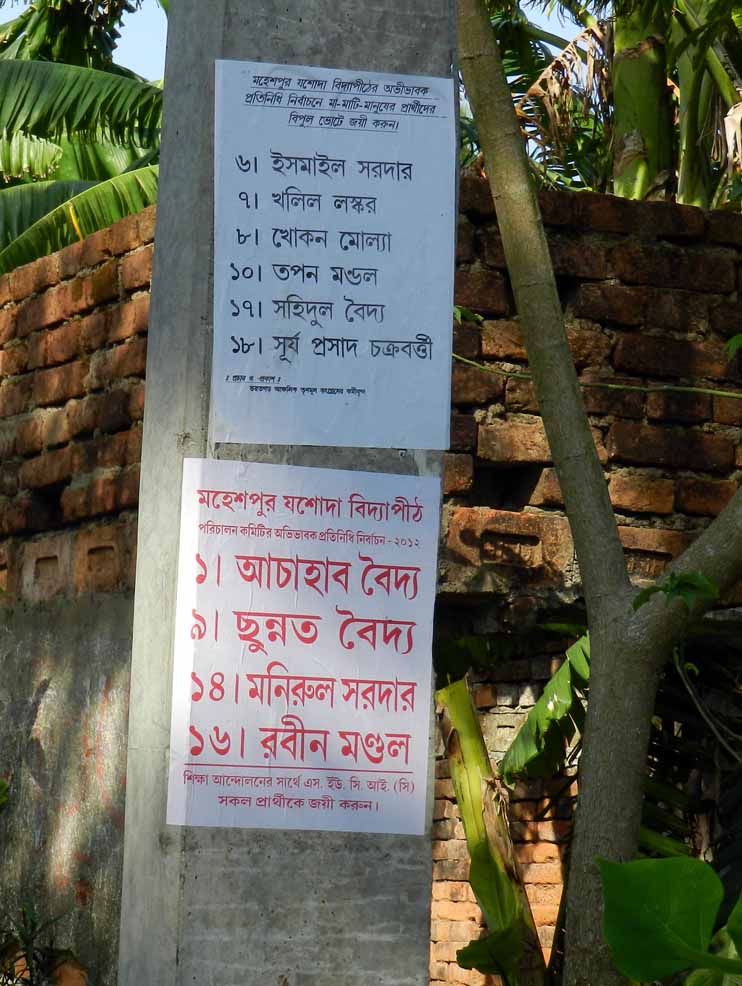
The school is run by an elected committee. The committee members belong to different political parties and the electors are the parents of the students. All very well, but what do I see? Having stayed and studied in big cities I have never seen this excitement around a school election. Obviously they are all in the fray for big stakes. This election reached a crescendo last week. The contestants held meetings addressed by important political bigwigs, they campaigned door to door in the scorching sun and the rhetoric was acrimonious. For six seats in the school committee there are eighteen contestants. Some of them even cast aspersions on the reasons for the late Rakhal Chandra Pandit’s benevolence.

I asked around to understand this and was told that with the money drying up in the Gram Panchayats (village administration), the focus has shifted to the schools, as they are now considered milch cows. The list of candidates reveals much else.


The arrival of a contingent of policemen raised the ante in this otherwise sleepy hamlet. While writing this post I have been informed that the elections have passed off without incident.


Scratch Your B@!!$


Also in the last twelve weeks I have had few visitors from the city.  Smriti my partner of thirty three years and the ebullient Laurent Fournier have been the only exceptions. Piyali and Soumik came over for a day to discuss their projects for the proposed artists’ workshop. Chhatrapati too came with them and planned to stay a night. Just about when he had just dug in his heels and started to enjoy the photo - ops that Maheshpur presented him, the scare of a Tsunami tumbling over to Maheshpur sent panic waves through Kolkata and his family and friends made frantic calls for him to return. But, the person who sent some of the locals into a tizzy was Kaushik – Khoj Kolkata’s manager. Kaushik was born with physical disabilities which however has not deterred him from riding a motorcycle or climbing trees or excelling in the area of multi-media applications. In fact he has never tried to apply for anything under any handicapped quota. He does not consider himself to be incomplete or challenged. His ever smiling face and his willingness to extend himself is worthy of respect.


Kaushik posing in my "Canning Hat".
So, Kaushik arrives at the site on Saturday and is immediately surrounded by schoolboys and adults alike. They shamelessly stare at him and short of touching him they inspect his impediments.  This was irksome to say the least. I refrained from saying and held my peace. Then one of my workers gathered up enough gall to ask him, “What kind of accident were you in?”


“I was born this way,” Kaushik replied without the minutest change in his smile.


“Please don’t mind my saying so. But, I think you had done a lot of bad things in your past life,” the smart ass opined.


This got my blood boiling. I gave the smart ass a piece of my mind, but stopped short of telling him what I had heard only two weeks ago from a passing acquaintance in Maheshpur. This gentleman seemed to be well read and he had nothing but contempt for the locals. Allow me to narrate what he said.


“People here are all handicapped,” he suddenly started off. 


“Mentally and psychologically handicapped,” he clarified seeing my questioning gaze.


Before I could react and question him, he continued his tirade. “Most of them have one hand, because the other is busy scratching their b@!!$. If they could they would have applied for jobs and other opportunities under the handicapped quota! There are some who have no hands at all…both are occupied in like wise manner!” he signed off. I was bemused by all this as I had heard similar things being said many years ago about the Babus in Writers’ Building. That joke said that one could qualify for the job only if one does not have a condition known as monorchism. Full pay only if you can spend half a day scratching each b@!!


Yes, I am angry.


Olive Ridley Update


The construction is complete. I cannot show you a picture of the shelter without the bamboo scaffolding – Binoy has done the vanishing trick once again and the expert masons arrived two days late, necessitating an extended stay in the humid heat after the unsettling Nor’westers. Work on the clay interior has started and should be completed by mid-week. It now boils down to when all of this will dry off to allow for a coat of white wash inside. Dates for the artists’ workshop and the opening is therefore still in limbo. 

Ulu grass lining and preparation of clay.


Until next week friends!


For more details on Environment, Population, and Human Settlements of Sundarban Delta by Anuradha Banerjee log on to: 
http://books.google.co.in/books?id=zf_xv9LRd4cC&pg=PA161&lpg=PA161&dq=sundarban+land+lease&source=bl&ots=GDHM88oey1&sig=Jgojj8LGU5jbLTBdP4QNV4bY4Ts&hl=en&sa=X&ei=QAqUT6acB4KIrAf4


Saturday, April 14, 2012

Of Nor'westers & Earthquakes


Working in the Sundarbans, constructing the Olive Ridley shelter poses its own set of challenges as underlined in my earlier posts.  These challenges increase manifold when the weather becomes as unforgiving as it has been this past week.  Ever since I was old enough to understand what a Nor’wester or a Kal Baishakhi is – the sudden appearance of clouds on the horizon in late April or early May, darkening the sky within minutes and bringing with it rain and storm was all child's play. It was all so enjoyable from the dry comfort of home that we would wish that they came more frequently. But, our wishes were hardly ever met. In fact, it was just last year that we rued that they arrived late to quench this parched land.  One took its seasonal advent for granted and never bothered to listen to weather forecasts on the radio and television or discussed it on facebook.  The changing weather was a topic for casual comment and it still is among the fortunate classes.

Dark clouds. Picture courtesy Anirban Dasmahapatra

Back in the Sundarbans, perceptions are different. If it rains when it is supposed to rain, translates to a good crop - that is all.  Because, agriculture here is dependant on rain despite these islands being surrounded by water. The river waters are saline and is unusable for the purpose.  If the rains are delayed it is another story. If it rains too much there is the fear of floods. If storms are frequent and strong, it means loss or damage to life and property.  There is no romanticizing about the weather – that bit of luxury belongs in the domain of the more fortunate urban elite.  The unusual daily occurrence of Nor’westers this past week or so was therefore disturbing to the people of Maheshpur. The first storm had blown away walls and roofing of the most unfortunate of the village residents. They still sleep in makeshift shelters and are just about trying to stitch back their lives with odds and ends that can at best be considered temporary, even in good weather.  With Haradhan Babu on leave, Amal Babu worried about the safety of the children at the Ashram.


Then on last Thursday, the waters in the many ponds dotting this village started to sway. The effects of a distant earthquake manifested itself in this most interesting form. Everyone including women and children gathered around the larger ponds to watch this rare phenomenon.  That was when cell phones began ringing – people from Kolkata and nearby towns with access to TV started relaying news of the magnitude of the earthquake near Sumatra.  The TV channels went viral, trying to sensationalise the extent of the quakes’ effect on the city.  An old crack on a building was being passed off as a new one.  People panicked and to top it off there was a Tsunami warning.  All of this reached the ears of the people of Maheshpur. It got them worried.  The regular Nor’westers had already made their life difficult and such news reports only added to their dread.

The ebullient Laurent Fournier on the roof
Throughout the week I met people who have weathered many storms and they were all very eager to narrate their experiences from both sides of the border. They spoke not only of the magnitude of these storms and floods, but, also of the horrors they witnessed in their wake.  Having seen unimaginable destruction to life and property – living at the edge of civilization and at the mercy of relentless natural forces, they are wary even of small storms.


My work suffered a series of set backs due to slushy conditions. It rained heavily since the early hours of last Friday. The workers arrived and some of them left, thinking that there would be no work that day.  Seeing this, I told them that I did not intend to give up so easily. “The rain will have to stop sometime and we are going to apply the first coat of plaster to the outer dome”, I said.  So, the workers came back as did the Sun. Under the ebullient supervision of Laurent, work started in earnest.


Olive Ridley Update


We had organized a generator for lights in case we had to work after sunset – which we actually had to do, having lost a few hours to the rain in the morning. Then again, in the evening the skies rumbled and the lightning that tore up the darkness, revealed ominous thunderclouds. We were concerned that the plaster would get damaged, so, under windy conditions we managed to wrap the whole roof with fishing nets over plastic sheets.

The next morning as I was about to come back to Kolkata, I was relieved to hear that the covering had held.

The Olive Ridley shelter at night


All the bamboo work is done. The first coat of plaster has held and we plan to start on the mud floor and walls from Monday. Doors and windows have been designed and ordered. A few pieces of basic furniture with bamboo will also be made. This now boils down to how long it would take to dry out if this weather continues and we could move in for a five-day artists’ workshop before my eventful ‘daily passengery’ to Maheshpur will come to an end.


Coconut coir fibre inserted into the roof grid resembled "a hairy bug just about to start walking", said Laurent. Bottom right: The plaster work in progress.
Next week I hope to share with you pictures of a nearly complete Olive Ridley Shelter without the bamboo scaffolding coming in the way.

Sunday, April 8, 2012

Baro Mashey Tero Parbon


There is an adage that says “Bangalir Baro Mashey Tero Parbon” (Bengalees celebrate thirteen festivals in twelve months). Actually the saying is way off the mark – a survey needs to be conducted to arrive at the actual number of Hindu festivals celebrated in Bengal. A district-wise break-up is also necessary to reveal deeper truths. In the two months that I have spent in the Sundarbans I have already encountered about half a dozen. That is an average of three per month. Leaving aside the monsoon months when it would be difficult to celebrate anything but inundations, there could be eighteen festivals per year on a conservative estimate. Add to that the festival of other religious communities and compute the total number, one will realize the immense loss in man-days and how much work is realistically possible in a given year.

In the nine weeks since construction work on the Olive Ridley Shelter started, the number of working days excluding Sundays comes to 54 days – of which 12 days have been lost to festivals. That leaves us with 42 working days. With an average of 6 people working it translates to 252 man-days. Every week at least two of them will not turn up for work on two days – that is a loss of 36 man-days. Therefore of the 42 working days, we have effectively worked for 36 days! 36 days in two months. That is incredible India for you!

To top all of this, just when I was thinking that I have the schedule under my belt - they want to take off again for 2-3 days next week for “Charak Pujo”.  I try to reason with them and then try a bit of cajoling, but they are unrelenting. With a poker face I tell them, “Why don’t you postpone your festivities by a week?”

“The Gods won’t wait for us!” Bablu parries. Then realizing that I have the status of the employer, he adds, “If we could, we would have done that for you. But, everything is written in the almanac. We are powerless.”


Festivals are a way of life here – the brisk business of selling Ponjikas (Hindu almanacs) on the Canning Local is indicative of that. Gupta Press and Beni Madhab Sil are laughing all the way to their respective banks. Poor man’s loss is rich man’s gain. I am getting immensely frustrated with all this… and the frequent nor’westers is worrying.

Of course, one will say that I am speaking from an employer’s point of view, but, what about them – the workers? Every day they absent themselves they lose much needed income. It is well known that they have meagre opportunities of finding work here in the Sundarbans - the reason for the exodus to Kolkata and the general degradation that they have to face living in cramped shanties in the city. I am yet to fathom all this and understand the psyche of the people of the Sundarbans. 


On the brighter side much has been achieved in 36 days. That’s some consolation!

With all this and much more running through my mind, I go to bed only to realize that I will have to bear yet another night of Kirtan. I prick up my ears and I am surprised to hear the music of distant deserts…this is a Muslim version of the Naam Sankirtan.  I fall asleep to the pleasant, stretched-out melody born in the desert sands somewhere in the middle-east.

Olive Ridley Shelter: Update


The outer dome is complete in all respects waiting for the lime and sand plaster. The bamboos have been drilled node by node and the chemicals have been filled. The armature for the inner dome has been fixed with spacers to leave a gap between the two domes for air circulation. The bamboo matting for the inner dome and walls are ready and work on fixing them has started. The earth work on the ground floor is done and waiting for the final coat of clay slip. A long week is ahead of me and I am dreading the Kal Boishakhi (Nor’wester storms) and the absenteeism. Laurent will join me to start off the plaster work.


An evening of poems

Diganta accosted me one evening and insisted that I listen to him read out a few poems. I was surprised that he wrote poetry at such a tender age. But, my young friend turned up with a printed souvenir commemorating the golden jubilee of a reputed school in the Sundarbans. The poems were of uneven standard, but, most of it dealt with the flora and fauna of the area, extolling Sundarban’s beauty. These were so similar in content that it felt like West Bengal Tourism Corporation had commissioned them. After, about an hour of tedious poetry, I chanced to see the only poem written in English. I have removed the name of the school and the poet so as not to hurt sentiments, but, I really wished to share it with you without any comments (click on the picture for larger view). Enjoy!


 The First Nor’wester in Maheshpur

It hit with a swirling motion just as I was about to eat my lunch. I sat in the verandah next to the kitchen of the Ashram hoping it would not spoil my lunch. But the wind picked up speed and off flew chairs and clothing and everything that lay about. A big leaf came and landed on my plate. That was when I took refuge inside the kitchen to finish off my lunch. From the window I could see the destructive power of the storm and lashing rain. I quickly gobbled up my food and started enquiring about the children. Haradhan Babu had taken the usual initiative and had herded them indoors. But, the older ones ran around in the rain collecting hail stones and mangoes. They collected more than a tin load of them.

After the storm


When the rain and wind stopped I made ready to leave for Kolkata. With my back pack and camera bag slung across my shoulder I started walking towards our site through the now slushy village street.  The thatched hay roof of the boy’s hostel had gaping holes in it. A part of the school perimeter wall had crashed down.  As I advanced, all the destruction was there to see. Trees uprooted, branches broken off, houses damaged, roof cave-ins, et al. People were picking up things and searching for their belongings in the wreckage. On the way to Canning there were mangled electric poles and more damaged trees. I later learnt that the storm barely had a wind speed of 70kmph. I shudder to imagine what these people have in store for them if a super cyclone ever hits the Sundarbans.

The import of this first hand experience of a storm in the Sundarbans strengthens my belief that there should be more experiments to build smaller, stronger and low cost dwelling units here. I got on the internet back home and again searched for whatever I could find on Bamboo – the timber of the 21st century. Here is a link for you to get more information:


A happy Poila Boishak to all of you. Until next week then...

Sunday, April 1, 2012

Of Cell Phones & FM Radio


Riding in an auto rickshaw between Shibgunj and Maheshpur, one encounters a serene – in fact, pretty scenery on both sides of the brick-paved street. There are no signs of progress as would have been epitomised by the presence of electric poles and dangling wires. But, one does spot a few dish antennas. I have no clue about what kind of power they run on – I can only guess. But, despite the apparent low-incomes, one is surprised to notice how commonplace cell phones have become. Not being a compulsive shutterbug, I keep my camera in its bag and thus much of what I see remains only in my memory. I remember having seen on a few occasions, that women tending their small vegetable patches or attending to chores around the house - chatting away on their cell phones. Young men sport theirs like a badge of honour. Sitting next to some of them on a van rickshaw, I have noticed that they press buttons arbitrarily, proudly establishing ownership. One can make out that some of them are not literate enough to understand the number of complex applications these gizmos offer. But, the cell phone is not just a status symbol, it connects them to ‘their’ world and also symbolises 'their' aspirations – a tool that comes closest to the computer and will continue to be so until the electric poles and dangling wires arrive here in Maheshpur, as well as, in much of the Sundarbans.

However, I soon found out that there were other uses of the cell phone. Both, Binoy and Proshanto have cell phones that help them to keep in touch with me and relay instructions to the whole team working on site. They keep their phones close by and one or the other plays music to break the monotony of their working day. They soon realised that this was draining their batteries and opted to pool in money to buy batteries for Proshanto’s transistor radio. So, now the radio plays music and keeps up an incessant and inane chatter that presenters of FM stations always do. On one such afternoon, the radio was tuned into a programme of “Onurodher Ashor” (Listeners Request) on “Payel Betar” a local FM radio station based in nearby Kultali. The presenter chattered on with a caller and I suddenly realized that Binoy was on air requesting a song sung by Ram Kanai. The request was not met and Binoy started cursing. Proshanto tried next and his request too was not met. The others started making fun of the duo. Both the callers slunk away.

Binoy however, would not give up easily. He called again and requested another song. “Play a song by Radhanath Mandal!” he ordered.

“Let me see…whether we have that…” voiced the presenter and rang off.

Everyone split into riotous laughter. “What’s so funny?” I asked.

“There is no singer by that name!” said Binoy, his expression that of a school kid caught in a mischievous act and yet trying to suppress his mirth.

The next day it was Proshanto’s turn. He calls the FM station yet again. “I called yesterday and you could not play my request. My friend called you and you did not play his request. Today you must play my request. If you cannot play a song by Radhanath Mandal, you should close down your radio station!” He thundered. The presenter gave some lame excuse and switched on to some other caller. The same uproarious laughter like yesterday erupted. I was amused by all this and wondered about how a cell phone empowers these humble farm hands and carpenters.

Olive Ridley Shelter: Update

Entrance from the North-West corner.

The outer dome is finally done. It not only looks strong but it really is. About 4-5 people had been sitting on top of it to tie up the joints and I noticed that there was no ’bounce’. The four arches look good. The bridge and stairs have received simple railings. These look good too.

Clock-wise:Arches looking North-East, North-West, South-East, South-West.


People come in to have a look and there are streams of interesting comments. Two young boys saunter in one day, behaving like they own the place and are visiting to inspect the progress. The first, a confident looking lad tells his friend, “This is a bamboo fort.”

His friend, a bit younger and timid looking says, “I didn’t know that a bamboo fort looks like this!”

“This is what a bamboo fort looks like. It was always so”, the confident one asserts.


Of Photo-Chromatic Spectacles & Village Romeos

I have mentioned in an earlier post that I walk through the village from the Ashram to the site four times a day. On these walks I notice many things. Among them, the scenes that makes me want to behave like the teenager in the 1971 movie “Summer of ‘42”, is the sight of women bathing in their family owned ponds. Sometimes I am tempted to whip out my camera, but I desist from doing so. I respect their privacy and cannot blatantly intrude. But, the advantages of wearing spectacles with photo-chromatic lenses are immense. I have also perfected a style of walking I have invented called the “Shufflebug”, that slows down and picks up speed as and when the situation warrants. Without swiveling the head, my darting eyes take in much without exposing my voyeuristic intent.

In the city many women will wear a swimming costume or even a two-piece bikini at the poolside, but none would dare bathe and scrub in public. Here, in the village it is an entirely different scenario. Women, will not expose much while bathing in public. They would be wearing saris, but, the bathing process is long and languorous. Sitting on the paving or the makeshift ghat by the pond, they will soap their legs up to the knee – much like Smita Patil in the 1981 Hindi movie “Chakra”. They scrub their heels on the paving with a kicking movement that allows for quick darts of soapy hands up the sari covered thighs. Next, they wade into the water and take a quick dip, reappearing up to the neck while scrubbing all over. With the dark greenish water as privacy, off comes the blouse which is flung on to the paving. Some are even bold enough to stand waist deep, back facing the street, fling off the top of the sari and quickly hide under the water. The multi-coloured floating sari contrasts with the greenish water – leaving much to one’s imagination.

And what do the local Romeos do? Ogle of course. But, they have an interesting way of doing so. They will come up, make eye contact and ask “Boudi! Aaj ki ranna korlen?” (Sister-in-law, what did you cook today?) And she will answer. Thus, a steady banter will follow as long as the scrubbing under water continues. The episode ends with the woman emerging from the water in a clinging wet sari, deftly drape a dry gamchha around her upper torso and go indoors. This narrative is of course the sum total of many fleeting, fraction-of-a-second 'sightings' - I am in the Sundarbans, remember?

Pond with makeshift timber ghat


I thank all those who are reading this blog for your comments and encouragement and also for forwarding and sharing them with your friends. The blog statistics is looking impressive indeed. Thank you and continue to read, share and comment.


Sunday, March 25, 2012

Dreams and other narratives


After the forced break due to the festivities of the previous week, as mentioned in my last post, things are back to normal.  Work on the Olive Ridley Shelter has resumed. The Canning Local has not thrown up any new surprises and I have thus invented a guessing game to keep myself amused. If one doesn’t know the station names in between Canning and Ballygunge and looks down at the platforms, which are singularly filthy; shops take up most of the space, passengers crowd too close to oncoming trains and the only difference is the number of people on the platform that informs us about the status of a station.  Somewhat empty platform? So, where am I? Too much green? So, where am I? The peanut seller by the lamp post? So where am I? The markers are endless.

Apiluddin has not been able to ferry me this week as he is on school duty taking students to examination centres. So, I am being treated to smoother rides on the new auto-rickshaw of Gautam Bera. I go on my routine walks through the village four times a day. The children greet me with their uninhibited smiles and pester me with questions on their favourite subject -ghosts. 

Gopinath's ghost catching fish
The early morning tuition held for the children by Haradhan Bera wakes me up and I feel a little irritated. But, the evening classes are something that I look forward to. Haradhan Babu sits on the floor with about ten of the youngest boys around him. The sound track is mesmerizing. Haradhan Babu’s multi-tasking skills are unbelievable, switching from one lesson to the next – dividing his attention equally amongst his wards. His patience however, is tested at times. He prepares lunch for them when the cook is absent, pays attention to the minutest of details and swings a fishing net with aplomb early every morning – making the simplest of meals come alive. In between all his chores at the Ashram, he cycles home a few times to look after his own affairs which includes farming. I quite often hear him singing old Bengali songs on lazy afternoons. Haradhan Babu is a veritable one-man army.

Haradhan Babu with his wards


The days are getting hotter and the trek back to the Ashram for lunch is becoming daunting.  My crocheted hat, made out of synthetic fishing net yarn bought from a touristy shop in Canning helps a bit. Amal Babu has connected a pedestal fan to the solar powered battery in my room and cautions me that the battery is old and I should not use the fan indiscriminately.  I use the fan for about an hour in the afternoon after lunch as the asbestos roof heats up the room.


My hat!
It became unbearably hot one evening. I waited for Haradhan Babu’s class to end in the adjoining room and the lights were switched off there. I took a bath and cooled myself sitting in front of the fan. I continued to use it till I went to bed.

As soon as I had switched off my lantern and tucked in my mosquito net, the heat hit me like a sledgehammer. I started sweating, but tried to sleep – believing that once sleep overcame me, this sense of discomfort would soon be gone. I tossed and turned in bed until I drifted off…

I am on the platform of Canning station telling the man not to put sauce in my egg-roll. The train compartment is unusually empty.

Almost empty compartment


Taldi…
 “Dui akkey dui. Dui dugunay? Dui dugunay ki? Dui dugunay chaar. Ball, dui dugunay chaar.”

Betberia Ghola…
A bunch of giggly school girls swarm in.

Sweat trickles down my neck. I wake up, switch on the fan and go back to bed.

Ghutiari Sharif…
Loud green on the walls…a young couple is pushed closer by the fourth person crowding a three-seater bench.
 “Hongsho boltey hnash bojhaye. Bongsho boltey bnash bojhaye. Hongsho ki? Hongsho holo hnash”.
 “Why don’t you tie every alternate joint? You are wasting my time. At this rate we will never finish this house”.
The boy sitting on his father’s lap throws up. Much of the vomit re-enters through another window down-wind. There are shouts of protest.
The young couple cozy up. She readjusts the position of her large bag on her lap to accommodate and conceal her boyfriend’s arm.

Piyali…
”a - oi, khuku nachey ta-thoi-thoi.”
The elbow re-emerges from behind the bag. People on the opposite seat unabashedly ogle the pair. The couple smile at each other. Her face registers a tacit consent.

The sound of a crashing branch awakens me and I am concerned about the battery running down. I get up, switch off the fan and go back to bed.

More bamboos are unloaded. Someone in my team says “This is better quality”. Green turning to a pale yellow. They hit the bamboos below with a ‘thwang’ like the sound of a loose cello string.

Champahati…
A cleaner platform that invites you to explore this little town.
The peanut seller sells me two slim packets for five rupees each and offers it to me with the tops cut off.
“Chhoto khoka boley aw – aa, shekheni tow kotha kowa. What now? This is the third time in half an hour that you want to pee!”
The fourth passenger gets up and leaves. No one takes his seat. The couple sits close to each other for just a while longer and then moves away disappointed with their loss of an alibi.
A man takes off his shirt with vomit on it. Selects a clean part and wipes himself. Fishing out a polythene bag from his shoulder bag, he stuffs the shirt in and treats it with utmost distaste. All the while cursing and muttering about fathers who are careless about their children.

My sweat by now had taken on the force of the Matla in spate. I wake up, switch on the fan and return to bed.

Kalikapur…
The boyfriend gets up and readies to leave. The girl lifts up her bag to hide a pout intended only for him to see - as in a stolen farewell kiss.
“Ram boney phul pare…”.
“Kaku bon ki?”
“Bon janish na? Sundarbaner chhele! Bon holo giye Jongol…onek gaach!”

I had a fitful night and was bleary-eyed when the morning classes began. But, instead of my usual irritability, I pricked up my ears to catch every word of Haradhan Babu’s lessons.

The morning was blissfully breezy as I walked down to the site. I met Haradhan Babu on the way. “North winds! The children will be ill. I must tell them to keep their shirts on,” he said pedaling away. Later on during lunch time I told him how much I appreciated the good work he was doing with the children. He gave me a shy smile.

Olive Ridley Update

The roof structure is taking inordinately long. But, the bridge and the stairs are done. So is the ramp down from the bridge to the ground floor. The bamboo railings are waiting to be fixed. I hope to complete the outer dome by next week, HORI willing!

For those of you who did not understand this lingo – my apologies. I am inept at translating these into English. And to those of you who wish to know more about the Canning Local– there are sixteen stations between Canning and Ballygunge (both included). They are: Canning, Taldi, Betberia Ghola, Gaurdaha, Piyali, Champahati, Kalikapur, Bidyadharpur, Sonarpur, Narendrapur, Garia, Bagha Jatin, Jadavpur, Dhakuria and Ballygunge. The train goes further – the next two stations are Park Circus and Sealdah. Try it sometime – you might find grist for your mill!


Sunday, March 18, 2012

Of Battery Powered Noise & Other Distractions


In Maheshpur, I had expected relief from the incessant blaring of loud speakers from my neighbourhood Tara Ma temple in Calcutta. But, ever since I started staying in this village, my nights have been disturbed by loud speakers blaring devotional songs. I wondered how in this place, devoid of electricity, one could create such an immense racket. Battery powered havoc I realized to my horror! The sound carries very far due to the absence of buildings that act as baffle walls as in a city. Week after week the direction of this noise changed as each village in turn held a three to four, day and night long Horinaam Sankirtan. Now it’s Maheshpur’s turn.


On closer inspection of the handbill one notices that the programme is on the occasion of Bonodebi Mata’s Puja– a Hinduisation of Bonobibi: the Goddess of the forest. I will not write about Bonobibi here but, will once again recommend Annu Jalais’ book Forest of the Tigers for further details on the religious hierarchies of the Sundarbans. What I want to stress here is the power of the battery – it's giving me sleepless nights! I shudder to think what it will be when these villages are electrified. Of one thing I am sure – I will not be there to witness the decibel wars between competing villages.

Photo courtesy: Laurent Fournier
There is an irksome fallout of the Horinaam Sankirtan – some of my workers want to take leave to attend the festivities. “This is the most important annual festival here in Maheshpur”, they explain.  “So, Mr. Olive Ridley Shelter you have to wait. Religion comes first!” I tell the mute, half constructed bamboo skeleton.

Work had been stalled on more occasions than one for a variety of reasons and not being able to complete a project within a deadline is something that has never featured on my curriculum vitae. This is ridiculous! Expenses are mounting and I have a limited budget. I never believed that I would see this day. I tell myself not to get worked up. Working in the city is an entirely different ball game from working in the countryside with semi-skilled people. I confer with Binoy and decide to set strict deadlines for each week and hope that these are met. As I am a non-believer, I cannot even expect Hori to deliver.

Details of the roof work in progress


However, the structure is taking shape and that is my only consolation. There is much that remains to be done and hope they are achieved without any more hold ups.


Art Practices: Intended & Otherwise

Prasun has relieved me from spending the whole week in Maheshpur and I am ‘relieved’. He too has time on his hands when in the Ashram. Having struck a chord with the boys there, he has initiated them into clay modeling. He called me up to say that there were a lot of stuff under my bed and that I should photograph them for this blog. I found out that there was a lot of small works in clay in various stages of disintegration. The cat must have been at it or it could have been the large field rat that often scurries out when I enter my digs. However, I get the boys to take them outdoors for the shoot. I separate them in terms of subject. There was a lot of clay pots with wilted real flowers stuck into them. A few birds, carts and trucks, but what caught my attention was the number of diesel generator and pump sets.


Phelu
These too were falling apart and looked like they belong in a junkyard. I shot them accordingly. This is a photograph by me of an installation of objects created by the children, directed by Prasun. The youngest member of the Ashram – Pathik, a three year old, Phelu for short, picked up the biggest of the generator-pump set-combo and claimed he had done it. I played along and told him that he had done a very good job. Emboldened, he decided to drive home his advantage, “Ami sob korechhi!” (I did it all) he proclaimed.

As for myself, I had taken along a few small canvases and they sat in my room for weeks. The light of the solar lantern did not encourage me to even try to confront these whites.  Finally, I did use them. A precious gift of a good camera helped in no uncertain terms. The canvases were waiting for images and that is what they received. It is a study of shadows cast by the Olive Ridley Shelter in progress.

Shadows

 Canning Local Update

Well almost. This is an update with a poser. Does the “scratchitti” in the train compartments - an expression of passenger frustration, qualify as protest art?


 I leave you with this question. Until next week then!